

Online Tuition or Classroom for MCA Oral Exams
The question is rarely whether a marine engineer needs to revise for an MCA oral examination. The real decision is how to revise effectively around sea time, leave periods, work commitments and the pressure of progressing to the next Certificate of Competency. For candidates weighing up online tuition or classroom study, the best answer depends on their current knowledge, confidence when speaking aloud and the stage they have reached in their career.
An EOOW candidate building core knowledge has different requirements from a Second Engineer preparing to defend fault-finding decisions, or a Chief Engineer candidate discussing management, legislation and safe operation at a senior level. Both online and classroom learning can be valuable. What matters is whether the method gives you structured technical revision, regular verbal practice and clear feedback on weak areas.
What the MCA oral examination is really testing
An MCA oral examination is not simply a test of how much information a candidate can recall. The examiner is assessing whether you can think and communicate as an engineering officer. You may be asked about a machinery fault, a safety-critical procedure, statutory responsibility or the practical steps required following an incident. A sound answer needs technical accuracy, a logical sequence and a clear understanding of risk.
This is why passive revision is seldom enough. Reading a manual or memorising model answers may improve familiarity with a subject, but it does not automatically prepare you to explain your reasoning under examination conditions. Candidates need to practise answering aloud, receive challenge questions and learn where their explanations are unclear, incomplete or unsafe.
The choice between learning formats should therefore be based on performance, not convenience alone.
Online tuition or classroom: the practical differences
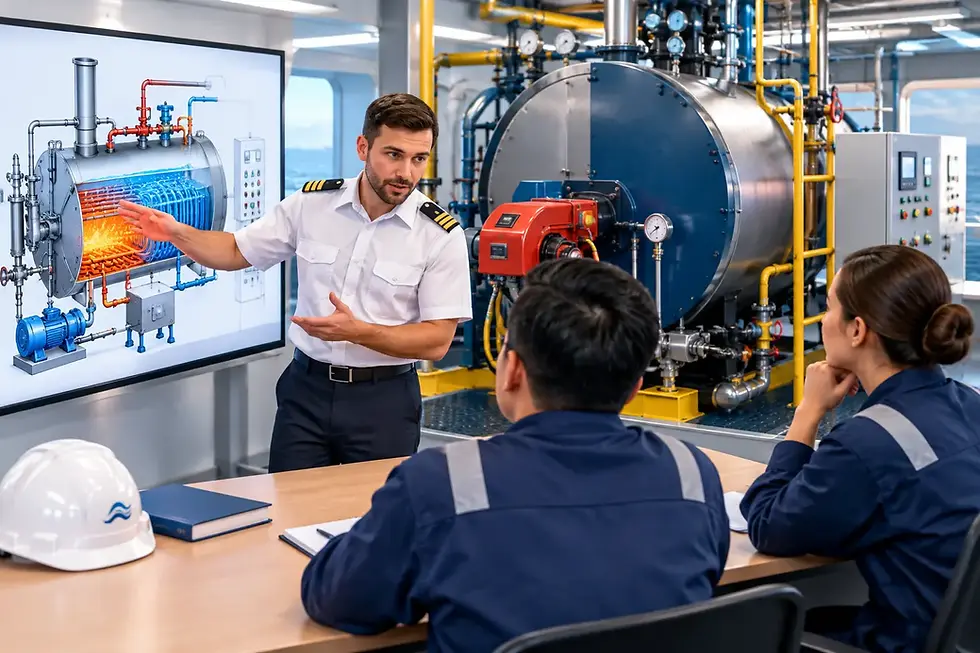
Classroom tuition offers a fixed setting, direct interaction and a defined timetable. For some candidates, particularly those early in their preparation, this structure is useful. Attending a scheduled session can create discipline, reduce distractions and make it easier to ask questions as a group. A capable tutor can also use the room to develop discussion around a system, a diagram or a realistic operational scenario.
However, classroom learning has limits for seafarers. Courses often run on set dates in a particular location, which may not match crew changes, travel arrangements or short periods of leave. A candidate may also feel reluctant to expose a knowledge gap in front of colleagues, especially when revising for a senior certificate.
Online tuition changes the practical equation. It allows revision to continue from home, accommodation ashore or, where connectivity permits, while working away from a training centre. Sessions can be more focused on the individual candidate's certificate level, recent experience and weaker subjects. It is also easier to return to a topic several times rather than relying on a single intensive course.
That flexibility is useful, but it requires self-management. Online learning can become irregular if a candidate has no plan, no target dates and no expectation to practise verbally. The format works best when it is treated as professional preparation rather than something fitted in only when time allows.
When classroom tuition is the stronger choice
A classroom environment may be the right option when a candidate needs external structure or benefits significantly from face-to-face discussion. This can apply to cadets who are still connecting college theory with engine-room practice, or to candidates returning to study after a long interval.
It can also be valuable for group-based learning. Hearing how other engineers approach a question can reveal alternative ways of structuring an answer. For example, a discussion on boiler water contamination, crankcase explosion precautions or emergency bilge pumping may move beyond a textbook response into the practical decisions expected on board.
The strongest classroom sessions do not merely deliver information. They create repeated opportunities to explain procedures, justify decisions and respond to follow-up questions. If the course is largely lecture-based, candidates should ensure they also have time to practise the oral element independently.
Location and travel are practical considerations. A well-run course can be worthwhile, but not if travel consumes time that would otherwise be used for focused revision, rest and preparation. Candidates should weigh the value of attending against the disruption to their leave and examination timetable.
When online tuition is the better fit
Online tuition is particularly effective for candidates who need regular, targeted support over several weeks or months. Instead of attempting to cover every subject in a short block, the candidate can work through the syllabus in stages, identify gaps and revisit difficult areas with an experienced marine engineer.
For EOOW candidates, that may mean strengthening the foundations: watchkeeping responsibilities, propulsion systems, pumps, separators, electrical safety, pollution prevention and emergency actions. At this level, confidence often improves when technical principles are linked directly to what the candidate has seen in the engine room.
For Second Engineer and Chief Engineer candidates, online sessions can be tailored towards the quality of the answer rather than simple subject coverage. Senior oral examinations require a candidate to show judgement. A discussion about a main engine failure, fuel contamination, planned maintenance deficiency or statutory survey should demonstrate priorities, communications, risk control and the wider responsibility of the role.
One-to-one or small-group online practice also gives candidates room to make mistakes safely. A tutor can stop an answer, ask for clarification and challenge an assumption in the same way an examiner may do. This helps replace vague or overlong responses with a calm, structured explanation.
The format matters less than the learning method
A candidate can attend an excellent classroom course and still struggle if they only listen. Equally, an online learner can make rapid progress if they follow a disciplined programme. The deciding factor is active practice.
Effective MCA oral preparation should include candidate-reported question themes, but it must not stop there. Questions should be used to identify the underlying knowledge required: why a procedure is followed, what could go wrong, which regulations or company processes apply, and how an officer should act in a real situation.
A practical routine has three parts. First, revise the technical subject until you can explain it in plain, professional language. Next, answer a question aloud without reading notes. Finally, review the answer honestly: did you address safety, sequence, reporting, isolation, testing and documentation where relevant? This cycle is more valuable than repeatedly rereading a polished answer.
Interactive oral-question resources can support this approach by allowing candidates to work through topics by certification level and identify areas needing further tuition. TST Engineering’s preparation approach is built around this type of structured, practical revision, with an emphasis on developing confident spoken answers rather than simply accumulating notes.
How to choose the right support for your level
Before booking tuition, consider what is actually holding you back. If you understand the subjects but become hesitant when questioned, prioritise mock oral practice and feedback. If you are unsure of core systems or legislation, begin with a structured technical revision plan before attempting intensive mocks.
EOOW candidates should look for support that develops dependable fundamentals and avoids unnecessary complication. The aim is to show that you can keep a safe engineering watch, understand machinery operation and respond correctly when conditions change.
Second Engineer candidates should be ready to discuss supervision, maintenance, defect management and operational decision-making. They need to move from describing equipment to demonstrating how they would manage people, risks and priorities.
Chief Engineer candidates should prepare for the broader responsibility of the role. Their answers should reflect technical authority, safety leadership, compliance, communication with the Master and company, and the ability to manage serious machinery or personnel issues without losing control of the situation.
In every case, choose tuition that permits questions, challenges assumptions and provides feedback that is specific enough to act on. General encouragement is useful, but progress comes from knowing precisely what to improve before the next session.
A blended approach often gives the best result
For many candidates, the most effective solution is not strictly one format or the other. A classroom course can provide momentum and broad subject coverage, while online tuition can maintain progress before and after the course. Online mock sessions are especially useful close to the examination, when candidates need to sharpen delivery, fill remaining gaps and practise working under pressure.
This blended approach also reflects the realities of a seagoing career. Professional competence is developed over time through study, experience, reflection and discussion with others. No single revision day replaces that process.
Choose the environment that helps you practise consistently, speak with clarity and understand the operational consequences of every answer. The aim is not to sound rehearsed. It is to enter the MCA oral examination able to demonstrate safe judgement, sound engineering knowledge and readiness for the responsibility of the next rank.


Comments