top of page

TST Blog - Be Part of Our Journey

If you are searching for a MIN 654 oral readiness guide, you are usually past the point of casual revision. By this stage, most candidates have read the notice, reviewed the syllabus and spent hours with notes, yet still feel exposed when they picture the examiner asking, “Chief, talk me through your actions.” That is the gap that matters. The MCA oral is not a memory test alone. It is an assessment of judgement, safe practice, statutory understanding and your ability to speak like an engineer who can be trusted onboard.

MIN 654 oral readiness guide

MIN 654 tells you what the examiner can ask. It does not, by itself, make you ready to answer under pressure. Readiness comes from being able to connect regulations, plant knowledge, onboard routines and emergency decision-making in a clear spoken format. Candidates often know more than they show because their answers are poorly structured, too brief, or drift into theory without relating back to shipboard reality.

A good oral performance sounds operational. If you are asked about a purifier fault, a boiler low water condition, steering gear checks, enclosed space entry or a blackout recovery, the examiner is listening for sequence, priorities and control measures. He is not looking for a textbook recital. He wants to hear what you would actually do, what you would check, who you would inform and what regulation or company requirement sits behind that action.

What MIN 654 is really testing

MIN 654 is often treated as a topic list. That is useful, but incomplete. The oral examination tests three things at once.

First, it tests technical competence. You must understand systems well enough to explain operation, fault-finding and limitations. If you cannot explain why jacket water temperature control matters, what causes scavenge fires, or how a sewage treatment plant can fail in service, your knowledge will not hold up once the examiner starts probing.

Second, it tests statutory and safety awareness. Marine engineering officers are expected to know the practical application of SOLAS, MARPOL, ISM, safe working practices, permit systems, emergency preparedness and survey requirements. This is where many otherwise capable engineers lose marks. They answer the engineering part adequately but become vague when asked about records, reporting lines, certificates, testing intervals or legal responsibilities.

Third, it tests command presence. Even at EOOW level, the MCA is judging whether you can think in an ordered way and communicate safely. At Second Engineer and Chief Engineer level, that expectation rises sharply. Your answer must reflect leadership, supervision, risk awareness and accountability.

How to use this MIN 654 oral readiness guide properly

The strongest candidates do not revise everything with equal intensity. They prioritise by likelihood, weakness and consequence. Start by splitting your preparation into four working areas: plant knowledge, legislation, emergencies and oral delivery. If one of these areas is weak, the whole performance suffers.

Build from your own ticket level

EOOW candidates should focus on watchkeeping judgement, machinery operation, bunkering safety, pollution prevention, permits to work, alarms, emergency procedures and basic legislation. Second Engineer candidates need a broader command of maintenance planning, statutory surveys, machinery management, manning of emergency response, dry dock preparation and defect escalation. Chief Engineer candidates must sound like senior managers of technical risk, class and flag compliance, engine department leadership and commercial consequence.

One common mistake is studying above or below your level. If you are preparing for Second Engineer, do not answer like a cadet describing components only. Equally, do not force a Chief-level answer that sounds rehearsed and unrealistic. Pitch matters.

Turn syllabus points into spoken answers

Reading MIN 654 silently is passive. Oral readiness begins when each topic becomes a spoken response. Take a heading such as fuel oil system, starting air system, oily water separator or steering gear. Then answer three questions aloud: what is the system for, what can go wrong, and what are your actions as the responsible engineer.

That method exposes weak areas immediately. Many candidates can label equipment but struggle to explain consequence. For example, if asked about low lube oil pressure, the answer should not stop at “alarm will activate”. You should be ready to cover possible causes, immediate checks, load reduction if appropriate, bearing protection, purifier contamination risk, filter differential pressure, pump changeover and communication to the bridge if propulsion may be affected.

What good MCA oral answers sound like

A strong answer is structured. It usually follows a simple sequence: identify the risk or defect, state immediate safety actions, explain technical checks, reference reporting and records, then mention prevention or follow-up.

Take a purifier high vibration alarm. A poor answer is, “I would stop the purifier and inspect it.” A much better answer is, “I would assess whether the purifier can be safely isolated or whether immediate shutdown is required based on severity. I would check for bowl imbalance, incorrect assembly, sludge build-up, bearing condition or abnormal feed condition. I would ensure no overflow or pollution risk, transfer to standby unit if fitted, inform the watchkeeping team, and investigate before restart in line with maker’s guidance and engine room procedures.”

That answer is better because it shows control, prioritisation and awareness of consequences.

Areas candidates most often underestimate

Legislation is one. Engineers who are excellent onboard sometimes become uncertain when asked where authority comes from. You should know the practical purpose of key conventions and codes, but you also need enough detail to discuss application. If the examiner asks about MARPOL Annex I in relation to bilge handling, he is unlikely to be satisfied by hearing only “prevent pollution”. He may ask about discharge criteria, equipment approval, Oil Record Book entries, bypass risk, port state implications and master notification.

Another weak area is emergency management. Candidates often revise incidents as isolated technical failures instead of command situations. A blackout is not just a fault tree. It is also bridge communication, situational awareness, essential services recovery, propulsion implications and post-incident investigation.

Human element questions are also becoming more noticeable. If asked about fatigue, permit failures, near miss reporting or poor toolbox talks, answer as a professional responsible for standards, not as someone repeating company posters.

Practical preparation that actually improves performance

Mock oral practice is where progress becomes measurable. Not all revision improves oral results. Hours spent reading can create false confidence if you never test recall under pressure.

Use short, aggressive practice sessions. Sit down with a topic, answer without notes, then review what you missed. Record yourself if needed. You are listening for hesitation, weak sequencing, filler language and points where you lose technical accuracy.

It also helps to practise with challenge questions. If you say, “I would isolate the system,” ask yourself how, from where, with what effect on connected machinery, under what permit, and what you would do if the isolation point failed. MCA examiners regularly probe one level deeper than the answer you first give.

If you are working with a coach, the value is not just extra questions. It is having an experienced engineer identify whether your answer sounds operational, whether your language reflects MCA expectations and whether you are avoiding or exposing your weak spots. A candidate can be technically sound and still fail if the delivery suggests uncertainty.

Common mistakes in the oral exam room

The first is answering too quickly. Fast answers are often shallow and untidy. Take a moment, frame the scenario, then speak clearly.

The second is trying to impress with jargon. Examiners do not need theatre. They need competent, safe reasoning. Plain technical language is better than overcomplicated wording.

The third is failing to declare assumptions. If the question is broad, it is acceptable to state the operating condition you are assuming. That shows maturity. For example, “Assuming the vessel is underway and the main engine remains available, my first actions would be…” That is better than giving an answer that only fits one scenario.

The fourth is not closing the loop. If you discuss a defect or incident, finish with verification, records and prevention. Engineers are expected to restore, report and learn.

FAQ

Is MIN 654 enough on its own to pass the MCA oral?

No. MIN 654 defines the scope, but passing depends on how well you apply that knowledge verbally. You need operational understanding, not just topic recognition.

How do I prepare for MCA oral exam questions in the UK?

Prepare by turning each MIN 654 topic into spoken answers, then test yourself under pressure. Focus on technical systems, legislation, emergencies and clear verbal structure.

What do examiners want in a Second Engineer oral answer?

They want to hear safe management of machinery, prioritisation, supervision, statutory awareness and clear decision-making. The answer should sound like a senior watchkeeper ready for departmental responsibility.

How can I improve confidence before the oral exam?

Confidence usually improves when your preparation is specific. Practise aloud, work on weak topics, and rehearse follow-up questions rather than reading more notes.

Are MCA oral exams more about theory or practical knowledge?

They are about practical application of theory. If you cannot relate knowledge to real machinery operation, maintenance, emergency response and compliance, the answer will feel incomplete.

The best use of a MIN 654 oral readiness guide is not to collect more information. It is to sharpen how you think, how you speak and how you justify your actions as an engineer trusted with a live ship. When your answers begin to sound like the decisions you would make at sea, you are getting close.
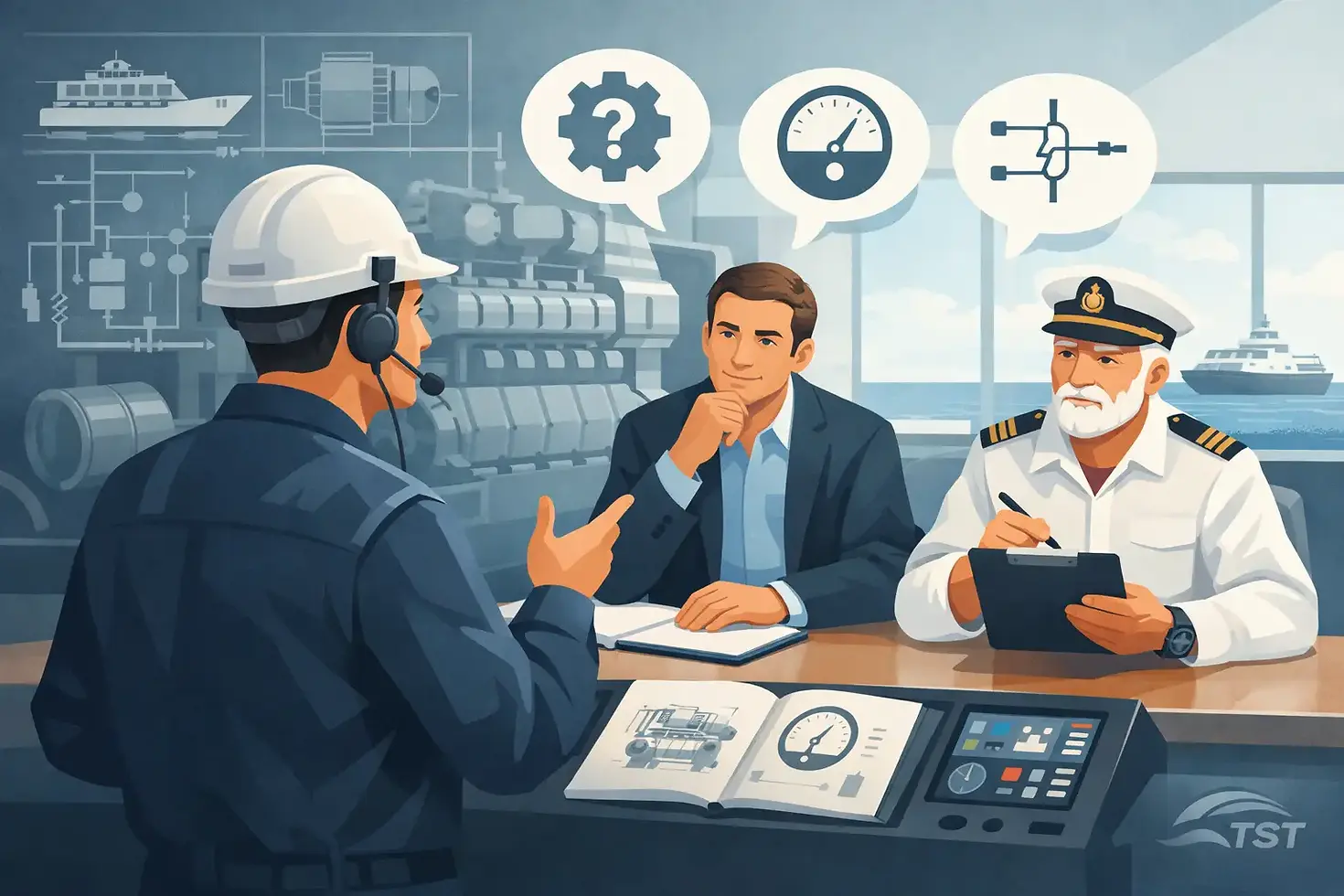


If you are asking what questions come up in MCA oral, you are usually asking the wrong thing in only one sense: the MCA oral is not a bank of fixed questions to memorise. It is an assessment of whether you can think and respond like a certificated engineer under pressure. That said, the questions are rarely random. They tend to come from repeatable technical areas set out by the Notice of Eligibility, the applicable syllabus, and the examiner’s need to test judgement, safety awareness, legal knowledge and practical shipboard competence.

What Questions Come Up in MCA Oral?

The best way to prepare is to understand the style of questioning, the common technical themes, and what the examiner is trying to prove about your readiness for the next certificate of competency.

What the examiner is really assessing

In the MCA oral, the examiner is not looking for polished classroom answers. He or she wants to know whether you can operate safely, make sound decisions, and justify your actions as an engineer officer. That applies whether you are sitting EOOW, Second Engineer or Chief Engineer oral.

A candidate may know a textbook definition of crankcase explosion, but the examiner is more interested in what alarms you expect, what immediate actions you take, how you protect personnel, and what checks you complete before restarting machinery. That is the pattern across most of the oral. Knowledge matters, but applied knowledge matters more.

MIN 654 is relevant because it sets the wider expectation around oral preparation, scope and certification pathway. In practice, your questioning will usually move between operations, legislation, safety, maintenance, emergencies and management of the engine department. The level of depth changes with the certificate.

What questions come up in MCA oral by topic

Safety and emergency response

This is one of the most reliable areas for questioning. If your answers are weak here, the examiner will notice quickly.

Expect questions on fire in machinery spaces, fixed fire-fighting systems, emergency bilge suction, steering gear emergencies, blackouts, enclosed space entry, flooding, collision damage, and loss of propulsion. You may be asked what you would do, in what order, and why.

A typical question might be: you have a purifier room fire with dense smoke and one motorman unaccounted for - talk me through your actions. That question is testing emergency response, communication, boundary cooling, mustering, isolation of fuel and ventilation, and whether you understand command structure. If you answer with only “raise the alarm and use CO2”, you have missed the practical sequence.

Main propulsion and auxiliary machinery

You should expect questions on the systems you have actually sailed with. The examiner will often start from your testimonial evidence or sea service and move into familiar plant.

For EOOW, common questions include starting air systems, jackets and pistons cooling, lube oil systems, purifier operation, air compressors, boilers, steering gear, refrigeration and sewage treatment. For Second Engineer oral, the examiner will usually go deeper into fault diagnosis, planned maintenance, system failures and operational limitations. For Chief Engineer level, questions move further into management, class and statutory implications, defect reporting, risk, dry dock planning and safe operation of the whole technical plant.

A practical example would be a question on low scavenge temperature, high exhaust temperature on one unit, or repeated purifier sludge discharge faults. The examiner is looking for method. Can you identify likely causes, assess immediate risk, avoid making the fault worse, and explain what you would inspect first?

Oral questions on legislation and statutory compliance

Many candidates underprepare this area because they prefer machinery. That is a mistake. The MCA oral expects engineers to understand the legal framework they operate within.

Questions often come up on MARPOL annexes, SOLAS machinery requirements, ISM, ISPS awareness, MLC where relevant to engineering management, oil record book entries, bunkering precautions, SOPEP response, sewage and garbage controls, and survey responsibilities.

You may be asked simple opening questions such as what goes into the Oil Record Book, but the follow-up is where candidates are caught out. For example: a chief officer asks you to pump oily bilge water overboard because the OWS is unavailable and you are short of tank capacity - what do you do? The correct answer is not only that you refuse. You should explain the legal breach, the reporting line, the need to escalate, and the importance of accurate records and lawful alternatives.

Human element and management questions

At higher levels especially, expect more questions on leadership, fatigue, permits to work, toolbox talks, supervision of contractors, and management of multicultural engine room teams.

These questions are not soft options. An examiner may ask how you would deal with an experienced fitter who repeatedly ignores isolation procedures, or how you would manage handover after a machinery defect on arrival. Good answers show technical authority and professional control, not aggression.

Electrical, control and automation questions

Even non-ETO candidates should be ready for electrical and automation questions appropriate to their level. Blackout recovery is a standard area. So are protection devices, synchronising, load sharing, insulation monitoring, emergency generator operation and fault finding on motors and starters.

One common line of questioning is a blackout scenario. What tripped first? What starts automatically? What services are restored by the emergency generator? When would you reconnect machinery, and what checks would you make before bringing propulsion back online? This sort of question separates candidates who know systems from candidates who know only definitions.

How the questions are usually framed

Candidates often imagine the oral as a rapid-fire quiz. In reality, many examiners use layered questioning.

They may begin with a broad prompt such as, “Tell me about the boiler water tests you carry out.” If your answer is structured and confident, the examiner may move on. If it is vague, they will drill into chemistry control, blowdown, consequences of poor test results, and safe dosing practice.

Another common method is the scenario question. Instead of asking for a regulation by number, the examiner places you in an operational situation. This is deliberate. Ships do not fail in multiple-choice format. They fail at 0200 with alarms sounding and incomplete information.

The strongest candidates answer in a sequence: immediate safety, stabilise plant, inform relevant personnel, investigate cause, control risk, record actions, and only then discuss restoration to service.

What questions come up in MCA oral at each level

EOOW

EOOW questions usually test whether you can keep a safe watch, respond to machinery alarms, understand core systems, and follow procedures correctly. Expect operational questions on pumps, heat exchangers, purifiers, compressors, boiler mountings, steering gear, bunkering and pollution prevention.

You should also be able to explain your actions as a watchkeeper. If a high bilge alarm sounds, if the main engine trips, or if fuel oil pressure fluctuates, what do you do first and what must be reported?

Second Engineer

Second Engineer oral questions move into deeper technical ownership. The examiner expects stronger fault diagnosis, maintenance planning and supervisory judgement. Dry dock preparation, defect management, class and statutory repair considerations, and management of engine room staff become more prominent.

At this level, weak answers often come from speaking too generally. If asked about a stern tube high temperature alarm or repeated auxiliary engine crankcase mist detection alarms, you need to show a practical, disciplined response.

Chief Engineer

Chief Engineer oral questions are less about doing every task yourself and more about accountability. Budget pressures, defect deferment, survey interface, emergency command, SMS implementation and legal responsibility all come into play.

You may be asked what you would do if the vessel is commercially pressured to sail with a known defect. The examiner wants to hear a lawful, defensible engineering decision, not a vague promise to “monitor it”.

How to prepare for MCA oral exam questions properly

Do not revise by reading model answers passively. Speak your answers aloud. The oral exposes hesitation, poor structure and shaky understanding very quickly.

Start with your own ship experience. If you sailed with medium-speed diesels, prepare every major support system around that plant. If you have tanker time, prepare cargo-related engine room risks properly. Then map your experience against the certificate syllabus and fill the gaps.

Use three-part answer structures. First, state the issue clearly. Second, explain your actions in order. Third, justify why. That keeps your answer disciplined under pressure.

It also helps to prepare for the examiner’s natural follow-up. If you say you would isolate a faulty pump, be ready to explain how, what permit or risk assessment may apply, what redundancy exists, and what the consequences are if the standby unit fails.

Mock orals are valuable because they expose where your knowledge stops being operational and starts becoming memorised. A good coach will challenge assumptions, interrupt weak answers, and make you defend your decisions in real time. That is far closer to the actual MCA oral than reading another set of notes.

FAQ

Are MCA oral exam questions repeated?

Yes, topic areas repeat regularly, but exact wording and follow-up questions vary. The examiner will adapt the discussion based on your certificate level, your sea service and the quality of your first answer.

Does the examiner only ask from my ship type?

No. Your own shipboard experience is often the starting point, but you can still be asked wider syllabus questions relevant to the certificate of competency.

How much legislation do I need for the MCA oral?

Enough to show safe and lawful professional practice. You do not need to recite every regulation number, but you do need to understand what the law requires and how it applies on board.

What is the biggest mistake candidates make?

Trying to recite memorised answers without showing judgement. The oral is designed to test whether you can think like an engineer officer, not whether you can repeat notes.

How should I answer scenario questions?

Start with safety of personnel, then stabilise the machinery or situation, communicate, investigate methodically, and explain the reasoning behind your actions. Keep your answer practical and in sequence.

If you prepare for what questions come up in MCA oral in that way, the exam becomes far more manageable. You are not trying to predict a script. You are proving that when the pressure comes on, your knowledge is organised, usable and fit for the certificate you are applying for.


A candidate who can recite definitions often still struggles in the MCA oral because the examiner is not marking a written answer. He is testing judgement, prioritisation and whether you sound like an engineer who can take charge in a machinery space at sea. That is why the best questions for oral exam practice are not just broad theory prompts. They are the ones that force you to explain what you would do, in what order, and why.

Best Questions for Oral Exam Practice

For UK MCA engineering candidates, especially under the structure and expectations reflected in MIN 654, the quality of your practice questions matters more than the quantity. If your revision is built around passive reading, you may know the syllabus but still underperform when challenged verbally. Good oral practice questions expose weak areas, improve technical recall under pressure and train you to answer in a safe, operational sequence.

What makes the best questions for oral exam practice?

The strongest oral exam questions do three things at once. First, they test knowledge of systems, regulations and procedures. Second, they make you speak in a structured way. Third, they reveal whether your answer reflects real shipboard decision-making.

A weak practice question might ask, "What is a purifier?" That only checks basic memory. A better question is, "You suspect poor purifier efficiency during heavy weather. What signs would you look for, what checks would you make, and what action would you take before the situation affects fuel supply to the main engine?" That question is closer to the standard expected in an MCA oral because it brings in observation, diagnosis, risk and corrective action.

In practice, the best questions are usually scenario-led. They still require technical knowledge, but they also test your ability to think like a watchkeeping or senior engineer. That is what examiners are listening for.

The question categories that matter most

If you are preparing for EOOW, Second Engineer or Chief Engineer level, your practice should cover several recurring areas. The exact depth depends on your ticket, but the pattern is consistent.

Safety and emergency response

These questions are often where candidates either settle the examiner or create doubt. You must answer with a clear order of actions, communication lines and safety precautions.

Typical strong questions include: what would you do if there is a crankcase oil mist detector alarm, how would you respond to a scavenge fire, what are your actions following a boiler low water level alarm, and how would you manage a fuel leak onto a hot surface in the engine room.

A good answer starts with immediate safety and plant protection, then isolation, communication, verification and follow-up. Candidates lose marks when they jump straight into dismantling or troubleshooting without first controlling the risk.

Operational engineering questions

This area covers the practical running of machinery. Examiners often use these questions to judge whether you understand cause and effect.

Examples include preparing a main engine for standby, changing over fuel systems before entering an emission control area, dealing with high exhaust temperatures on one unit, or tracing the cause of low jacket cooling water pressure. These are strong practice prompts because they force you to explain systems as working equipment, not as textbook diagrams.

Legislation and MCA expectations

Many candidates neglect this area because it feels less practical. That is a mistake. In the oral, you are expected to connect engineering actions to statutory responsibility.

Questions might include your duties under MARPOL when handling bilge water, what records are required for oily water separator operation, how you would respond to a deficiency affecting class or statutory compliance, or what the chief engineer's responsibilities are regarding planned maintenance and safe manning support. If you answer technical questions well but become vague on legislation, the examiner may doubt your readiness for certification.

Leadership, management and human factors

At senior levels especially, examiners are not only testing machinery knowledge. They want to know whether you can manage people, workload and risk.

Strong questions include how you would brief a junior engineer before maintenance on pressurised systems, what you would do if an oiler repeatedly bypasses instructions, or how you would handle fatigue affecting engine room performance. These are useful because they test professional judgement, not just engineering detail.

Examples of the best MCA oral practice questions

The best practice set includes questions that require explanation, not one-line replies. Below are the types worth using regularly in your preparation.

System understanding questions

Ask yourself to explain how a system works, then move straight into failure response. For example, explain the starting air system and then explain the dangers of starting air line explosions and the safeguards fitted. Or explain the central cooling system and then describe what would cause contamination between fresh water and seawater sides.

This method is effective because the examiner often starts with basic system knowledge and then shifts quickly into defects, alarms and consequences.

Fault diagnosis questions

These are among the most useful for oral preparation because they mirror real engine room thinking. For instance, your auxiliary engine is smoking black and carrying uneven load after maintenance. What are the likely causes, what would you check first, and what would you report if the fault persisted?

Questions like this teach you to avoid the common mistake of listing every possible fault without prioritising. In the exam, a disciplined sequence matters.

Emergency scenario questions

These are essential. Try questions such as: you have total blackout at sea, what are your immediate actions and recovery priorities? Or: the steering gear room is flooding, how do you respond from the engine department side? Or: there is a serious purifier fire, what machinery and fuel considerations affect your response?

These questions work because they combine emergency organisation, machinery knowledge and communication.

Oral follow-up questions

The MCA oral rarely stops at the first answer. A proper practice session should include follow-up pressure. If you say you would isolate a system, the next question should be how exactly you would isolate it. If you mention a safety device, the follow-up should ask how it works, how it is tested and what happens if it fails.

This is where many self-study routines fall short. Reading notes does not train you for professional cross-questioning.

How to build better answers under pressure

A strong answer in an engineering oral is usually built in layers. Start with the immediate action. Then explain the technical reasoning. Then state the checks, communication and safety controls. Finally, mention restoration, recording or longer-term corrective action if relevant.

Take a question on low lube oil pressure. A poor answer is, "I would stop the engine and check the pump." A better answer is to identify whether the pressure drop is genuine, assess alarm status and engine condition, reduce load or stop if required by severity and operating context, protect the machinery, check suction and discharge conditions, filters, temperature effects, relief valve behaviour and pump operation, and then report clearly to the chief engineer or bridge as appropriate.

That structure tells the examiner you are thinking as an engineer in charge, not as someone guessing parts.

Common mistakes when choosing practice questions

Many candidates revise the wrong way. They focus on obscure technical trivia, memorised definitions or very short question-and-answer sets. That creates false confidence.

If a question can be answered in one sentence, it is usually not enough on its own. If a question has no operational context, it may not prepare you for the way the examiner develops the discussion. And if your practice never includes speaking aloud, you are not really preparing for an oral exam at all.

There is also a level issue. EOOW candidates sometimes try to sound overly senior and become vague. Chief or Second Engineer candidates sometimes answer at too low a level and fail to show management judgement. The right question set should match the certificate of competency you are sitting.

How to use these questions effectively

The best results come from realistic repetition. Answer aloud, not silently. Time yourself. Record your answers and listen back for weak structure, hesitant language or missing safety points. Then repeat the same question a few days later and improve it.

It also helps to practise with someone who understands MCA standards and marine engineering operations. A knowledgeable coach or senior engineer will challenge your assumptions, ask the follow-up questions you are avoiding and stop you from rehearsing poor habits. That is often the difference between knowing the subject and presenting it convincingly.

FAQ

What are the best questions for oral exam practice for MCA engineers?

The best ones are scenario-based questions on emergencies, machinery faults, operational procedures, legislation and management decisions. They should make you explain actions in sequence, not just recall facts.

How do I practise for an MCA oral exam effectively?

Speak your answers aloud, use follow-up questioning, focus on real shipboard situations and practise by certificate level. Revision notes help, but verbal delivery under pressure is what must be trained.

Are MCA oral exam questions mostly technical?

No. They are technical, but they also test judgement, safety awareness, statutory understanding and your ability to prioritise correctly. The examiner wants evidence of competence, not just memory.

How many oral questions should I practise each day?

It depends on depth. Five well-developed questions with proper follow-up are usually more valuable than twenty shallow ones. Quality of response matters more than volume.

Should I use past questions only?

Past questions are useful, but they are not enough on their own. You need adapted and scenario-led questions that reflect how an examiner may change wording, challenge your answer or test the same topic from another angle.

A strong oral performance does not come from collecting more notes. It comes from facing the right questions until your answers sound like they belong to an engineer who can be trusted when the machinery does not behave as planned.


bottom of page