

Chief Engineer Oral Revision Strategy That Works
The Chief Engineer oral is not won by trying to recite every regulation, fault or formula you have encountered at sea. It is won by showing the examiner that you can think and act as the person ultimately responsible for a vessel’s machinery space, safety systems, engineering team and operational readiness. A sound chief engineer oral revision strategy therefore has to develop technical recall, but also judgement, prioritisation and the ability to explain your decisions aloud.
For a Second Engineer progressing to Chief Engineer, the change in expected standard is significant. Questions may begin with a familiar technical problem, but the discussion quickly moves towards command responsibility: what action you would take, whom you would inform, what risks must be controlled, and how you would maintain safe operation and regulatory compliance.
Begin with the Chief Engineer’s role, not a question list
Revision is most effective when every topic is viewed through senior-engineer responsibility. Rather than asking, “What is the correct answer to this question?”, ask, “What would a Chief Engineer need to know, decide and record in this situation?”
Take a main-engine crankcase alarm as an example. At Second Engineer level, you may be expected to explain the possible causes and immediate machinery actions. At Chief Engineer level, you should also be ready to discuss the bridge communication, risk of fire or explosion, safe shutdown decision, company reporting, preservation of evidence, subsequent inspection and the management of the engineering team during the response.
This approach stops revision becoming a collection of isolated facts. It connects technical systems with safe management of the vessel. That is the standard the oral examination is designed to test.
Build your revision around the MCA syllabus areas
A Chief Engineer oral preparation plan should cover the full breadth of the applicable MCA syllabus, while giving additional attention to the subjects where your operational exposure is limited. Candidates often revise the machinery plant they know best and postpone unfamiliar areas such as dry-docking, statutory certification, pollution prevention, high-voltage safety or emergency management. Those gaps are often exposed under questioning.
Organise your study into practical subject groups: propulsion and auxiliary machinery, electrical and control systems, safety and emergency response, pollution prevention, legislation and certification, shipboard management, dry-docking and surveys, and fault diagnosis. Use the syllabus as your master checklist, then divide each group into smaller revision sessions.
Do not treat regulations as separate from engineering. A question about an oily water separator, for instance, may involve plant operation, discharge requirements, record keeping, malfunction reporting and the Chief Engineer’s duty to prevent an improper discharge. The strongest answers demonstrate that these responsibilities are connected.
Identify weak areas honestly
Make a simple traffic-light assessment of every syllabus area. Green means you can explain the subject clearly without notes. Amber means you recognise the subject but require prompts. Red means you could not give a safe, structured answer under pressure.
Your red subjects should lead the plan, not be avoided. If you have never been involved in a dry-dock specification, do not try to disguise that lack of experience with vague statements. Study the purpose of the docking plan, scope of work, safety controls, class and statutory involvement, sea valves, tailshaft work, hull protection and testing before return to service. Then practise explaining how you would manage the process as Chief Engineer.
Use a weekly plan that produces spoken answers
Reading technical manuals has value, but silent revision alone does not prepare you for an oral examination. You need frequent opportunities to retrieve knowledge and speak it in a logical order.
A practical week might include two technical-system sessions, one legislation and management session, one emergency scenario session, and one mock oral session. Keep individual study blocks focused. An hour spent answering six questions aloud, checking the gaps and repeating them is often more useful than three unfocused hours reading notes.
At the end of each session, write down the questions that caused hesitation. Revisit them within a few days, then again the following week. This spaced repetition is particularly useful for statutory requirements, survey intervals, certification, alarm settings and procedural sequences that can fade when you are away from the books.
If you are still serving at sea, make revision fit the watchkeeping routine and maintenance workload rather than waiting for a perfect study period. Short, regular sessions in port or after duty are more sustainable than an ambitious timetable that collapses after a few days. The quality of your attention matters more than the length of the session.
Practise the structure of a senior officer’s answer
The examiner needs to hear your reasoning. A technically correct answer can lose strength if it is delivered as disconnected points, or if you move into repair details before explaining the immediate safety position.
For operational and emergency questions, use a consistent sequence:
1. State the immediate danger and make the situation safe.
2. Explain the first actions for machinery, personnel and communications.
3. Describe how you would assess the fault or condition.
4. Set out the corrective action, monitoring and any limitations on operation.
5. Cover records, reporting, investigation and measures to prevent recurrence.
This is not a script to force into every answer. A short definition question needs a short, direct response. However, for scenarios involving fire, flooding, pollution, machinery damage, electrical hazards or unsafe work, this structure demonstrates control and sound professional judgement.
Use clear language. Say what you would do, why you would do it and what could happen if it were not done. Avoid filling pauses with uncertain speculation. If a question depends on a vessel’s specific design, say what information you would check, such as the approved procedures, maker’s instructions, safety management system, drawings or statutory requirements.
Revise from scenarios, not only headings
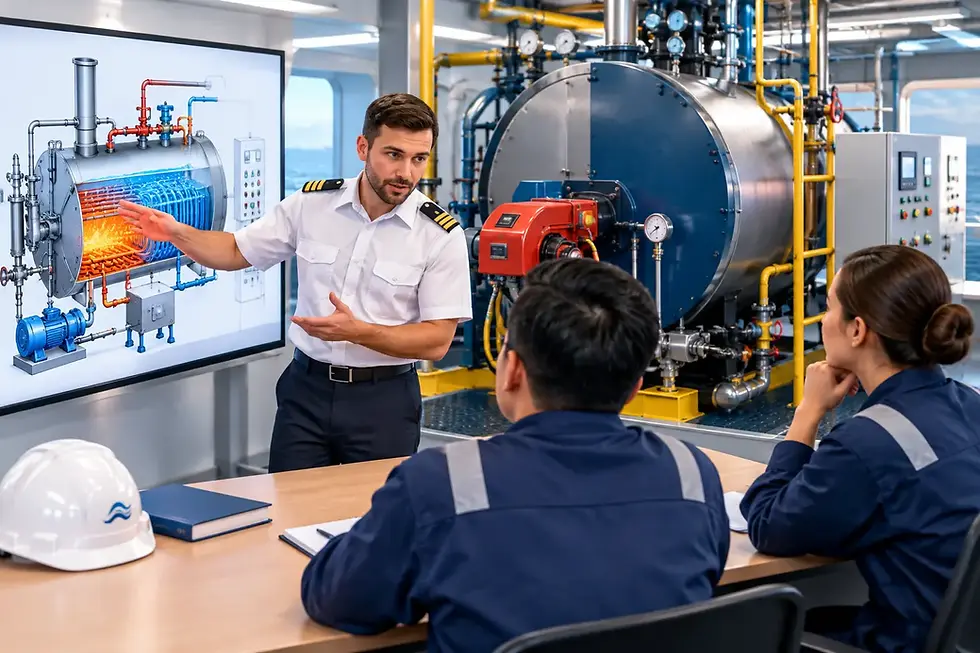
Chief Engineer questions commonly test how several areas of knowledge come together. A blackout can lead to questions on emergency generator arrangements, steering gear, bridge liaison, restarting essential auxiliaries, alarm systems, risk assessment, maintenance history and post-incident reporting. A boiler problem may develop into combustion safety, fuel changeover, water treatment, safety valves, survey requirements and management of repairs.
Build scenario cards around realistic events: main-engine failure in confined waters, total loss of electrical power, high bilge level, purifier fire, refrigerant leak, steering gear failure, accidental oil spill, flooding in an unmanned space or a serious injury during maintenance. For each scenario, answer aloud before checking your notes.
The aim is not to predict an exact examination question. Candidate-reported oral questions can help reveal recurring themes and the expected depth of discussion, but they are revision prompts rather than official MCA examination papers. Use them to test understanding, not as answers to memorise.
Keep legislation current and operational
Senior oral candidates are expected to understand the purpose of the regulations they refer to. Memorising a convention title without being able to apply it to a shipboard decision is rarely convincing.
When revising legislation, connect each requirement to a practical responsibility. Consider what certificates, records, drills, inspections, training, equipment or procedures support compliance. Think about the consequence of non-compliance for people, the environment, vessel operations and the company.
Regulatory material can change, and ships may operate under different flags, class requirements and company procedures. Check current MCA guidance and approved onboard documentation where relevant. In the examination, do not claim a fixed interval or requirement unless you are confident of it. It is better to explain the governing principle and state that you would verify the current requirement than to provide a precise but incorrect answer.
Make mock orals part of the strategy
Many capable engineers struggle because their first genuine spoken practice happens in the examination room. A mock oral exposes a different problem from private study: you may know the subject, but lose the answer when interrupted, challenged or asked to justify a decision.
Practise with another engineer where possible. Ask them to interrupt, ask follow-up questions and move from theory to a casualty scenario. Record some sessions and listen for weak habits such as overlong introductions, unexplained acronyms, rushed answers or repeated phrases such as “I think”.
Interactive question banks can also provide valuable structured practice when a study partner is unavailable. TST Engineering’s Chief Engineer revision resources are designed to help candidates work through question themes repeatedly, identify weaker areas and build confidence in explaining technical decisions under pressure.
Treat experience as evidence, not a substitute for revision
Your own sea service is one of the strongest resources available. Think through faults you have attended, planned maintenance you have supervised, inspections you have supported and emergencies or near misses you have witnessed. These examples help you explain how procedures work in reality.
However, experience has limits. A candidate may have extensive time on one engine type, vessel trade or company system while having little exposure to another required area. Balance operational experience with systematic syllabus revision. The Chief Engineer oral examines your readiness for the certificate, not only the tasks your previous vessels happened to require.
Approach each revision session as preparation to make a safe decision with incomplete information, a busy engine room and a ship depending on your judgement. That mindset will make your answers clearer, calmer and far more credible when the examiner asks the next question.


Comments