


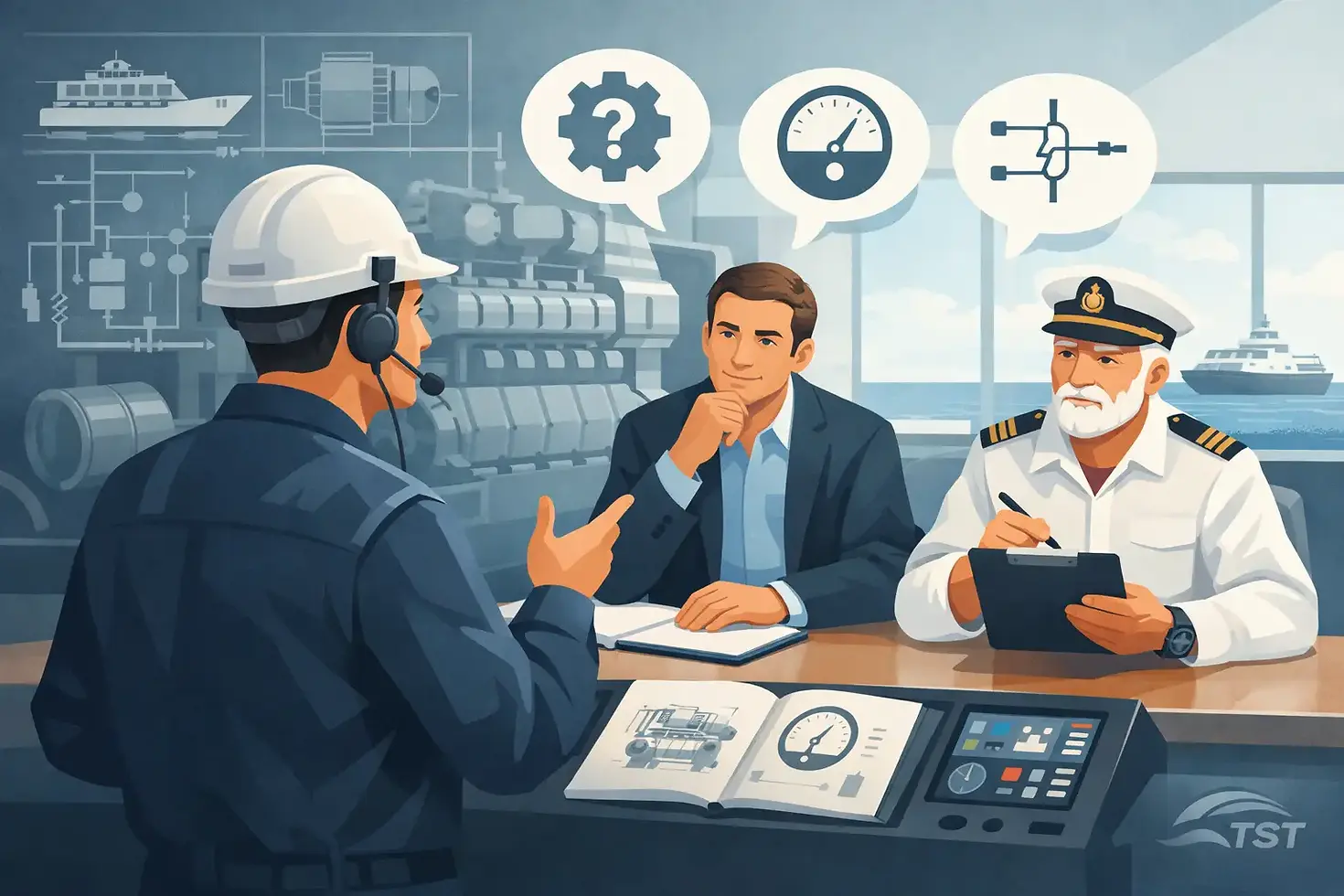
What Questions Come Up in MCA Oral?
- Antony Tubman
- Apr 13
- 7 min read
If you are asking what questions come up in MCA oral, you are usually asking the wrong thing in only one sense: the MCA oral is not a bank of fixed questions to memorise. It is an assessment of whether you can think and respond like a certificated engineer under pressure. That said, the questions are rarely random. They tend to come from repeatable technical areas set out by the Notice of Eligibility, the applicable syllabus, and the examiner’s need to test judgement, safety awareness, legal knowledge and practical shipboard competence.
What Questions Come Up in MCA Oral?
The best way to prepare is to understand the style of questioning, the common technical themes, and what the examiner is trying to prove about your readiness for the next certificate of competency.
What the examiner is really assessing
In the MCA oral, the examiner is not looking for polished classroom answers. He or she wants to know whether you can operate safely, make sound decisions, and justify your actions as an engineer officer. That applies whether you are sitting EOOW, Second Engineer or Chief Engineer oral.
A candidate may know a textbook definition of crankcase explosion, but the examiner is more interested in what alarms you expect, what immediate actions you take, how you protect personnel, and what checks you complete before restarting machinery. That is the pattern across most of the oral. Knowledge matters, but applied knowledge matters more.
MIN 654 is relevant because it sets the wider expectation around oral preparation, scope and certification pathway. In practice, your questioning will usually move between operations, legislation, safety, maintenance, emergencies and management of the engine department. The level of depth changes with the certificate.
What questions come up in MCA oral by topic
Safety and emergency response
This is one of the most reliable areas for questioning. If your answers are weak here, the examiner will notice quickly.
Expect questions on fire in machinery spaces, fixed fire-fighting systems, emergency bilge suction, steering gear emergencies, blackouts, enclosed space entry, flooding, collision damage, and loss of propulsion. You may be asked what you would do, in what order, and why.
A typical question might be: you have a purifier room fire with dense smoke and one motorman unaccounted for - talk me through your actions. That question is testing emergency response, communication, boundary cooling, mustering, isolation of fuel and ventilation, and whether you understand command structure. If you answer with only “raise the alarm and use CO2”, you have missed the practical sequence.
Main propulsion and auxiliary machinery
You should expect questions on the systems you have actually sailed with. The examiner will often start from your testimonial evidence or sea service and move into familiar plant.
For EOOW, common questions include starting air systems, jackets and pistons cooling, lube oil systems, purifier operation, air compressors, boilers, steering gear, refrigeration and sewage treatment. For Second Engineer oral, the examiner will usually go deeper into fault diagnosis, planned maintenance, system failures and operational limitations. For Chief Engineer level, questions move further into management, class and statutory implications, defect reporting, risk, dry dock planning and safe operation of the whole technical plant.
A practical example would be a question on low scavenge temperature, high exhaust temperature on one unit, or repeated purifier sludge discharge faults. The examiner is looking for method. Can you identify likely causes, assess immediate risk, avoid making the fault worse, and explain what you would inspect first?
Oral questions on legislation and statutory compliance
Many candidates underprepare this area because they prefer machinery. That is a mistake. The MCA oral expects engineers to understand the legal framework they operate within.
Questions often come up on MARPOL annexes, SOLAS machinery requirements, ISM, ISPS awareness, MLC where relevant to engineering management, oil record book entries, bunkering precautions, SOPEP response, sewage and garbage controls, and survey responsibilities.
You may be asked simple opening questions such as what goes into the Oil Record Book, but the follow-up is where candidates are caught out. For example: a chief officer asks you to pump oily bilge water overboard because the OWS is unavailable and you are short of tank capacity - what do you do? The correct answer is not only that you refuse. You should explain the legal breach, the reporting line, the need to escalate, and the importance of accurate records and lawful alternatives.
Human element and management questions
At higher levels especially, expect more questions on leadership, fatigue, permits to work, toolbox talks, supervision of contractors, and management of multicultural engine room teams.
These questions are not soft options. An examiner may ask how you would deal with an experienced fitter who repeatedly ignores isolation procedures, or how you would manage handover after a machinery defect on arrival. Good answers show technical authority and professional control, not aggression.
Electrical, control and automation questions
Even non-ETO candidates should be ready for electrical and automation questions appropriate to their level. Blackout recovery is a standard area. So are protection devices, synchronising, load sharing, insulation monitoring, emergency generator operation and fault finding on motors and starters.
One common line of questioning is a blackout scenario. What tripped first? What starts automatically? What services are restored by the emergency generator? When would you reconnect machinery, and what checks would you make before bringing propulsion back online? This sort of question separates candidates who know systems from candidates who know only definitions.
How the questions are usually framed
Candidates often imagine the oral as a rapid-fire quiz. In reality, many examiners use layered questioning.
They may begin with a broad prompt such as, “Tell me about the boiler water tests you carry out.” If your answer is structured and confident, the examiner may move on. If it is vague, they will drill into chemistry control, blowdown, consequences of poor test results, and safe dosing practice.
Another common method is the scenario question. Instead of asking for a regulation by number, the examiner places you in an operational situation. This is deliberate. Ships do not fail in multiple-choice format. They fail at 0200 with alarms sounding and incomplete information.
The strongest candidates answer in a sequence: immediate safety, stabilise plant, inform relevant personnel, investigate cause, control risk, record actions, and only then discuss restoration to service.
What questions come up in MCA oral at each level
EOOW
EOOW questions usually test whether you can keep a safe watch, respond to machinery alarms, understand core systems, and follow procedures correctly. Expect operational questions on pumps, heat exchangers, purifiers, compressors, boiler mountings, steering gear, bunkering and pollution prevention.
You should also be able to explain your actions as a watchkeeper. If a high bilge alarm sounds, if the main engine trips, or if fuel oil pressure fluctuates, what do you do first and what must be reported?
Second Engineer
Second Engineer oral questions move into deeper technical ownership. The examiner expects stronger fault diagnosis, maintenance planning and supervisory judgement. Dry dock preparation, defect management, class and statutory repair considerations, and management of engine room staff become more prominent.
At this level, weak answers often come from speaking too generally. If asked about a stern tube high temperature alarm or repeated auxiliary engine crankcase mist detection alarms, you need to show a practical, disciplined response.
Chief Engineer
Chief Engineer oral questions are less about doing every task yourself and more about accountability. Budget pressures, defect deferment, survey interface, emergency command, SMS implementation and legal responsibility all come into play.
You may be asked what you would do if the vessel is commercially pressured to sail with a known defect. The examiner wants to hear a lawful, defensible engineering decision, not a vague promise to “monitor it”.
How to prepare for MCA oral exam questions properly
Do not revise by reading model answers passively. Speak your answers aloud. The oral exposes hesitation, poor structure and shaky understanding very quickly.
Start with your own ship experience. If you sailed with medium-speed diesels, prepare every major support system around that plant. If you have tanker time, prepare cargo-related engine room risks properly. Then map your experience against the certificate syllabus and fill the gaps.
Use three-part answer structures. First, state the issue clearly. Second, explain your actions in order. Third, justify why. That keeps your answer disciplined under pressure.
It also helps to prepare for the examiner’s natural follow-up. If you say you would isolate a faulty pump, be ready to explain how, what permit or risk assessment may apply, what redundancy exists, and what the consequences are if the standby unit fails.
Mock orals are valuable because they expose where your knowledge stops being operational and starts becoming memorised. A good coach will challenge assumptions, interrupt weak answers, and make you defend your decisions in real time. That is far closer to the actual MCA oral than reading another set of notes.
FAQ
Are MCA oral exam questions repeated?
Yes, topic areas repeat regularly, but exact wording and follow-up questions vary. The examiner will adapt the discussion based on your certificate level, your sea service and the quality of your first answer.
Does the examiner only ask from my ship type?
No. Your own shipboard experience is often the starting point, but you can still be asked wider syllabus questions relevant to the certificate of competency.
How much legislation do I need for the MCA oral?
Enough to show safe and lawful professional practice. You do not need to recite every regulation number, but you do need to understand what the law requires and how it applies on board.
What is the biggest mistake candidates make?
Trying to recite memorised answers without showing judgement. The oral is designed to test whether you can think like an engineer officer, not whether you can repeat notes.
How should I answer scenario questions?
Start with safety of personnel, then stabilise the machinery or situation, communicate, investigate methodically, and explain the reasoning behind your actions. Keep your answer practical and in sequence.
If you prepare for what questions come up in MCA oral in that way, the exam becomes far more manageable. You are not trying to predict a script. You are proving that when the pressure comes on, your knowledge is organised, usable and fit for the certificate you are applying for.


Comments